

TryHackMe SOC Level 2: What Changed, and What It Says About the Future of the SOC Analyst Role
Exploring the new skills, technologies and investigative mindset behind TryHackMe's updated L2 curriculum


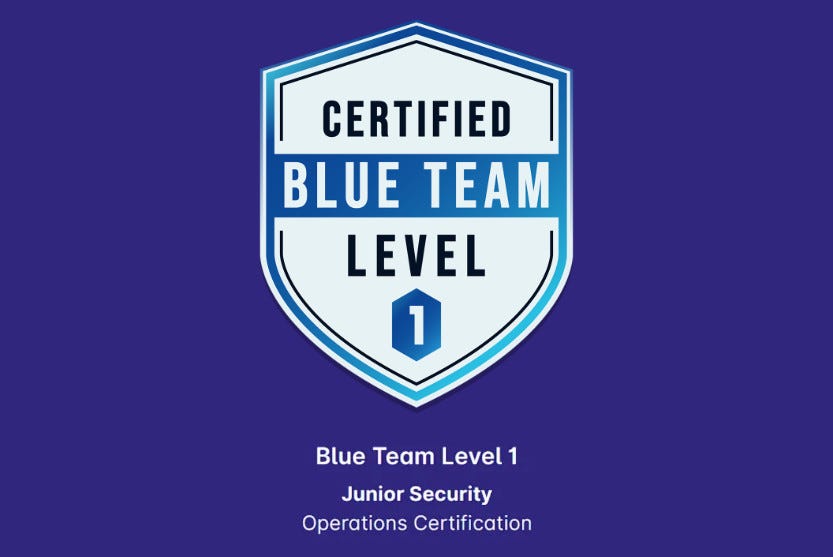
If you’re exploring entry-level cybersecurity certifications and wondering if the Blue Team Level 1 (BTL1) Certification is worth your time and effort, this article may help you decide.
Here, I’ll share my personal experience with the BTL1 certification , what it covers, how it compares to others, and why I believe it’s a great starting point for anyone aiming to work in a Security Operations Center (SOC) or related blue team roles.
One of the most compelling features of the BTL1 course is its strong emphasis on hands-on labs. Unlike many certifications that rely heavily on theory, BTL1 offers real-world exercises using industry-standard tools in the domains of Digital Forensics and Incident Response (DFIR).
These labs are not just academic tasks, they simulate realistic scenarios you’re likely to face in a SOC role, giving you relevant, job-ready experience.
While courses like the Google Cybersecurity Certificate are excellent for beginners, BTL1 dives deeper. It focuses on more advanced tasks a SOC analyst or cybersecurity professional may encounter daily. It bridges the gap between foundational knowledge and true operational capability.
This makes BTL1 a natural step forward for those who have completed entry-level certifications like CompTIA Security+, or for those with a basic understanding of cybersecurity who want to level up their skills.
BTL1 covers a wide range of technical and investigative skills across different cybersecurity domains. Some of the practical topics include:
The structure and content of these labs gave me a better understanding of real-world workflows, helping me feel more prepared to handle complex and diverse challenges in a professional setting.
BTL1 doesn’t neglect theory , quite the opposite. The theoretical content is comparable in depth to what I encountered while preparing for CompTIA Security+, but with a more practical focus and relevance to real-life blue team operations.
If you’re already Security+ certified, BTL1 can help you:
This combination of theory and practice really helped me internalize both the “how” and “why” behind each task.
The BTL1 exam is a 24-hour practical test with 20 randomly selected scenario-based questions.
You’ll use the same tools and techniques learned in the course to investigate incidents and answer questions. You can revise your answers throughout the 24-hour window before submitting. Results are delivered instantly upon submission.
Tips before taking the exam:
If you’re just beginning your cybersecurity journey, or want to try out the teaching style before committing, SBT offers a free junior-level course:
➡️ Blue Team Junior Analyst (BTJA)
This introductory course provides a great overview of blue team fundamentals and helps you get familiar with their platform and content quality, making it easier to decide whether BTL1 is right for you.
For me, completing BTL1 was an incredibly valuable experience. It helped me:
I strongly recommend BTL1 for anyone interested in roles such as:
If you’ve already earned certifications like Security+ and want to gain hands-on, practical experience in a blue team context , BTL1 is an excellent next step.
If you’re serious about building real, job-ready skills in cybersecurity, I highly recommend checking out the official course page:
Exploring the new skills, technologies and investigative mindset behind TryHackMe's updated L2 curriculum
Root Cause Analysis, Fixes and Lessons Learned During My SOC Homelab Deployment
A Complete Write-Up Demonstrating Real SOC Investigation Methodology